

Too often, annual planning turns into the creation of a rushed list of ambiguous goals paired with an optimistic budget that doesn’t reflect the real work ahead.
Proactive planning makes all the difference. It increases your team’s chances of success by making space to set clear priorities, outline the resources you’ll need, and spot gaps before they become critical roadblocks.
If your year starts in January, early fall is the perfect time to pause and build a future-proof operational plan for next year.
Here’s a simple framework to start your 2026 planning:
1. Define your top 3–5 strategic priorities for 2026.
What are the big bets, initiatives, or shifts that will matter most? Limit the list—fewer, bigger priorities give your team clarity and focus.
2. Identify what’s incremental.
Ask: will these priorities require new investment beyond what you already have in place? That could mean budget, people, or tools/software. Highlighting incremental needs early gives you more time to prepare strong business cases and avoid surprises later.
3. Map resources against priorities.
Take your expected budget and headcount for 2026, then layer in the tactical work that will continue (projects, client delivery, operations). Next, compare that baseline with the resources needed for your strategic priorities. Where do gaps emerge?
Example: 2026 Planning Guide
Here’s a simple planning matrix that helps bring this to life:
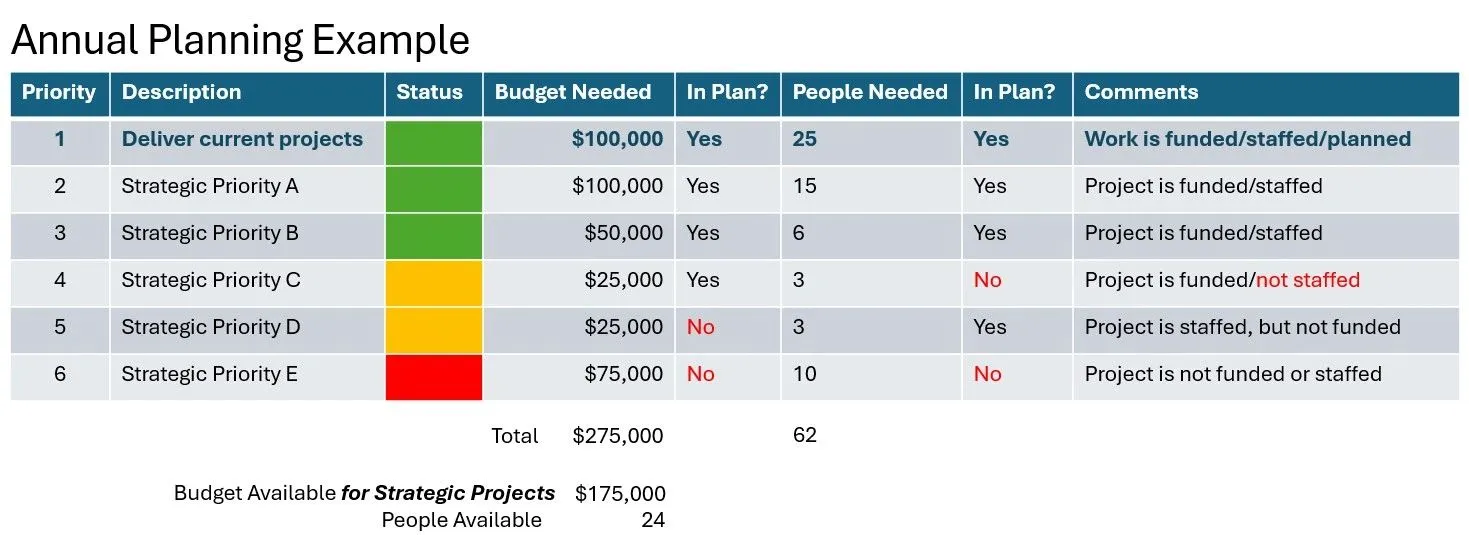
In this example, the total available budget is $275,000 and the team has 62 people available. The first line item represents current projects that must be delivered, leaving $175,000 and 24 people to assign to strategic projects in 2026. When we map those resources against the strategic priorities:
- ✅ Priority 1 is mandatory and gets funded and staffed first. Strategic priorities A & B are fully funded and staffed.
- ⚖️ For Priority C and Priority D, we can only choose one. We don’t have the resources (budget and people) to do both.
- ❌ Priority E is out of scope entirely—it has neither the budget nor the people needed to do the work.
This view highlights an essential truth: even with the best strategic priorities, execution depends on aligning them with the resources you actually have. When leaders see the tradeoffs clearly, they can make intentional choices—rather than spreading teams too thin or overcommitting to work that can’t be delivered.
Why this Matters
The real goal isn’t just to have a list of 2026 priorities. It’s to ensure your operational plan accounts for the full body of work—the tactical and the strategic—and that you have the people and dollars to deliver it.
By doing this work proactively, you give yourself time to:
- Validate assumptions with your team
- Build investment requests grounded in data
- Enter the new year with confidence that your 2026 plan is both ambitious and achievable
Final Thought
Robust annual planning requires aligning vision, work, and resources so your team can succeed without burnout.
This fall, give yourself the space to step back and ask:
👉 Do we have everything we need to deliver on the commitments we’re making for 2026?
At ModOps, this type of planning is a core strength. We help teams build operational plans that set them up for success – not just for the year ahead, but for the future they want to create.
📍 Schedule a ModOps Kickstart 💌Want tools like this in your inbox? Join our mailing list for smart, practical ops content each month.